4/01/2009

Video Gaming and Perceptual Processes


Game Developer's Conference 2009 is upon us.


At home, i rarely experience a personal moment that isn't soundtracked by my brother's nintendo/playstation/computer games. Off late i'm becoming increasingly concerned for him- the amount of time he spends in front of screens is ridiculous, and i'm sure there's actually a very small percentage of reality that his eyes see these days. It's exhausting even thinking about having to prise him away from his digiblip pseudo universe, and i sometimes wonder if he'll develop into what i conceive of as a normal human being. By this i don't mean that i think he is getting aggressive, or anti-social, or using games as a 'emotional vent' or all the other increasingly outlandish claims that 'psychologists' make in newspapers and TV. He's a pretty normal seven yr old, as are the majority of his classmates who are hardcore gamers.

But with this generation, growing up in an age where video games have gone past the loveably defunct graphics and thoughtless, mild mannered gaming of Atari and Sega days, turning more and more to cold, calculated, plotted shootings and murder that bend around basic ethics....something will have to give? I guess everyone wonders how this fantastic world of realistic gaming doesn't change the way kids perceive the world through a physical and communicative medium. Does it necessarily mean corruption?

This is what psychologists should really be interested in.


The past few days i've been studying perception and what it means to 'perceive'. i.e. is perception just an extension of our cognitive abilities? Or are there mechanisms that are uniquely perceptual processes. The basic idea seems to be that perception is a sort of 'slave' to higher-order processes like interpreting and understanding information and cannot be altered by how the participant 'desires' to see the world. BUT a perceptual system can be 'tuned up' to collect evidence of a particular type from the environment. A well known experiment is Blakemore and Cooper's kitty rearing study. Kitty H was grown up in an environment composed of horizontal lines, while Kitty V reared in a vertical environment. Recordings of single neurons in their brains showed that orientation-selective cells had a preferred orientation of within 45Âșof the exposed orientation in the environment. The kittens eventually became blind to lines and edges in the non-preferred direction. i.e. kitty H could not perceive vertical lines…

Essentially, perceptual systems at the heart of our biological make-up are sensitive to the environment, their sole purpose is to provide us with a valid account of what there is out there- A ‘best first guess’ is what they say. The action we take upon whatever we see is then up to our cognitive systems to interpret- but this can’t be done without a initial valid account of what we are actually ‘seeing’i.e. perception should be able to communicate effectively to the cognitive system that there is a rabid dog dripping with foam at the mouth running towards us, and the decision to run or lie down silently and wait our horrible death is up to the mind’s central processing unit. Most likely we will choose the first option, and hence perception is of an essential survival value- this makes a lot of sense. But what does this have to do with gaming?

I recently came across an informative article called
Rage Against The Machines’, with a refreshing view of video game culture. The article discusses gaming in the perspective of a product created by humans for humans, and therefore the incomprehensibility and insecurities that people have with gaming are entirely irrational. He discusses gaming constructively, with the impacts it has on the way children learn complex social behaviours, as a developing cultural activity (the PS game Ico is apparently visually based on the works of Giorgio de Chirico) and the place of gaming amongst other leisure activities such as reading and sport which gaming has relatively little economic impact on. The article actually mentions a bit from Richard Bartle’s biting article in the Guardian attacking those who discredit the future of gaming.

“Games are mainstream. Drown, or learn to swim”

Soon there will be a society where gaming will be a vital part of developing culture. What of these people? How will they work? How do they perceive? What will they turn into? Indeed Piaget's best work on child development did include 'learning through play'. This is just 21st century play.

Perception seems most important in our modern visual culture, more than it did in generations before. It makes me wonder sometimes whether the pressure of a visual culture is big enough to significantly alter the way our perceptual system works, starting from my brother's generation.

Games such as Bioshock and Mass effect with their uber fancy graphics and painstakingly detailed character descriptions lead individuals through fantastic worlds, where noone can be trusted, yet the need to engage and make a connecion with this freakish world is vital. Bioshock for example, is set in an alternate history 1960 in an underwater world called Rapture, Jack (player) must survive attacks by mutated beings that inhabit Rapture. It's full of DNA harvesting, ex-Nazi collaborators and complex moral decisions with bloodthirsty spatterings...


Bioshock

Mass effect

In reality we look for expressions in people's faces and body language to aid us in our social interactions with other people. In video games, there is no difference (oh apart from the fact that we're dealing with aliens and mutants). The world continues to destruct itself with violence and selfishness, innocent people die everyday, and everything seems to be spiralling into a grim and compassionless future. Maybe it's the hard skin and keen eye that develops from playing games like Grand Theft Auto and Bioshock that's needed to cope. 'Survival of the fittest' taken to the extreme.....

This is the kind of thing that they should include in dull cognitive psychology books.

In line with this i’ve been listening to The Advantage self-titled nintendoesque album- basically covers a lot of video game songs…

And also: This is shit hot.


3/24/2009

Dreams and Psychoanalysis: "A Cinematic Representation"

Magritte's Portrait of Edward James 1937


Hello, it’s Mango-has-gone-off-Monday! (well it was yesterday when i wrote this and forgot to post it)


So YESTERDAY i could make no mango smoothie because the mango had as you now know, completely gone off. Is it obvious that i’ve already stopped trying with these posts.....?

I came across this article today in the guardian on mental illness as a occupational hazard for poets. Mostly, i just enjoyed this part:


Batty and Wardle have both 'done time' on psychiatric wards and written resonant, gutsy and humorous poems about their experience”


Here we are, blistering evidence that mental illness in the long term increases everyone’s ability to be a creative tour de force (but conditions apply) on a mission to an ultimate utter lack of creativity (suicide). I’m not going to lie, among all the sadness of this month including Goody’s cancer-hit-and-run, i have undoubtedly found it difficult to keep the frown upside down. Getting as little sleep as possible allows me to avoid the point of contact where my unconscious finds ‘expression’ in the animated and illusory world of dreams. However, the past few days, an unbearable slumber has over ridden my otherwise unfailing adamance. The outcome: Teething Nightmares.


I’ve been having repetitive dreams of being shot, and always in an act of cowardice. i.e. the shooter will ask me to hand everything over, and tell him the whereabouts of my family and all my personal details, and if i do, he will leave me alone. Inevitably, i tell him everything, and then he turns around and shoots me heartlessly. Mostly, this occurs in the first person, but the other night, i dreamt that once i was shot, i realised i was a little girl and not myself. I had unwittingly walked into someone else’s body, and now enduring their pain. Then i had to watch the little girl being placed on a foreign hospital table, spurting blood; the bullet had hit her in the stomach, yet all this while, it was me who was feeling the pain, like i had replaced her soul with my own.


Even more bizarrely, the rest of the dream continued with me switching roles between myself, the doctor and my grieving mother, like some tireless schizophrenic. A sort of "DoppelgĂ€nger effect’ from the inside out (since i don’t tend to remember whether these people looked like me, but they all definitely were me in spirit). This was the only part that i was really interested in; the various infestations of me within different characters or ‘roles’.


The point of me saying all this is: i believe that a recurring dream must be something of significance. By the by, i came across a book entitled ‘Psychoanalysis and Cinema’ the other day. Normally i wouldn’t have the will to read something like this, but felt less compelled to rebuke it when i realised it was a well disguised coffee table reading handbook to the interpretation of dreams.


On cinema:


“ If you only knew how strange it is to be there, it is not life, but it’s shadow, it is not motion, but it’s soundless spectra”


Maxim Gorky (cited in Popple 1996:97)


The book was basically trying to address the fact that dreaming as the epitome in psychoanalytic interpretation is directly comparable to the big screen, in terms of both cinema and dreaming act as a type of ‘psychical apparatus’ in learning to tell the difference between what we perceive and what we imagine. Mainly so we don’t end up like Uncle Josh:


Josh here is unable to distinguish between the film and reality. This is a crude example, really.


I think uncle Josh is hallucinating, and it has nothing to do with the fact that he may be an idiot and can’t tell he’s watching a film. It’s a matter of being in the right place at the right time to hallucinate and have someone interpret that as your inability to perceive. Uncle Josh is a kind of ‘mirror’ that unites the external picture to the internal, his emotions are manifest in the screen, similar to how i felt mine were manifest in the other people in my dream. Again, i take this to be the inability of my self to distinguish between other people’s emotions and my own...


This is ultimately ‘doubling’/ idea of establishing an ego etc, which the book references to ‘Der Student Von Prag (The Student of Prague) using the idea of a ‘double’ where in the footprints of Faust, impoverished scholar Balduin gives up his reflection to a sorcerer in exchange for wealth. Silly boy. Balduin finally drives himself to suicide where he shoots the apparition of his double ultimately killing himself. Rather like that scene from Fight Club right at the end.


Der Student Von Prag...


So ultimately, i am no longer inclined to analyse my dreams in terms of Oedipus or the individuating ego because i am not that insane yet. Freud aptly implies that dreams show that a normal capacity for hallucination persists in us all: in other words, i should go to bed at a decent hour until furthur notice..


Next psychoanalysis and film installment will probably be on Hitchcock. Just kidding! Actually it will. But maybe first on inter-group processes...


Popple, S. (1996) ‘The Diffuse Beam: Cinema and Change’, in C. Williams (ed.) Cinema; in The Beginnings and the Future, London: University of Westminster Press, 82-99


3/18/2009

Sleeping in halves, Sleeping in wholes.

Man Ray, Solarisation 1931, © Man Ray Trust, Paris / VG Bild-Kunst, Bonn 2008
Ok, so now that i've reflected on my first post on this blog in a rather different frame of mind, it's obvious how ridiculously melodramatic that is (and there i was, hoping not to try and make epic introductions)

I'm a melodramatic person, it has to be said. I promise to not ever put anything quite as dramatic again. 

In my defense, i'm pretty lost in my work, lost in society, and lost in my head right now. This morning, i effectively just needed to get myself from my house to university since i'd unwittingly stayed at home the night before to sort some things out. Due to my knack for cutting off with reality, i had to drive back to my house 4 times after a half a journey completion down the dual carriage way to get an item i'd forgotten and crucially needed that day. That means i forgot four things four times and made a total of 8 half journeys. Amounting to what would have been 4 full journeys up and down. It was like a part of me was not even 'with me'. 

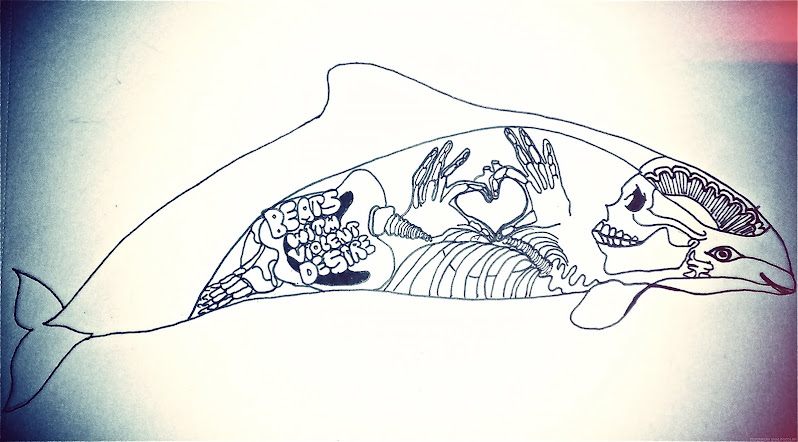
I was half asleep. This is pretty funny, because dolphins do this anyway quite literally. The two hemisphere of their brains sleep independently, and seems to serve as some crucial survival value- quite the opposite to the connotations of being 'half asleep'. 

I covered sleep some time ago in a tutorial. I think this video should be pretty interesting; i haven't really got round to all (6?) parts of it yet.


The Ugly Love: An introduction


As a wonderfully unsophisticated blogger, i’m going to try and pull this off.


Hopefully with some relative charm.


Last night, I was a disgracebook status ‘F.R.U.S.T.R.A.T.E.D’, at having come to the realization that a big part of my ‘interest spectra’ had almost totally disintegrated. Something that used to make me want to know more, was almost indistinguishable from the other things that i vaguely show an interest in and move along from just as hastily.


I’m being contradictory for a very good reason. I have an ugly love for Psychology:


Missable.

Replaceable.

Mostly now unfathomable.


At university, it is a rather dire science, that i sometimes feel is as cold as the laboratory. Just to demonstrate my romanticism; at the beginning of first year, i thought our lab sessions consisted of a mass of white coated first years observing wired bodies studying a Kanizsa figure or inkblots through a glass observatory. If not that, then at least some pigeon and coloured bulb action, please. It is not any of those things, instead we sit like zombies in front of computer screens calculating t-tests and pressing keys according to whether we see a word or non-word.


As a result of my failure to engage myself with my course, i'm having a bit of fun with it, starting a blog and what not. It's one last try of redemption for all those people, myself included, who have the ugly love.


Mostly, the blog will just be a ‘supplement’ to the topics i cover on my psychology course that will hopefully include art, music, films, books, interesting articles i happen to come across, and anecdotes from friends and strangers alike.


Bridging the gap between academia and general intrigue has never been more riveting. Because if i don’t have the motivation to keep this blog updated, then it inevitably means i don’t have the motivation to finish my course. If i do finish it, then it would be a complete and utter waste of my time.